




The first in vitro screening of L-citrulline RNA aptamers and their evolution into an L-arginine binder[1]
Timeline
Structural probing and damage selection of citrulline- and arginine-specific RNA aptamers identify base positions required for binding[2]
Another RNA aptamers that bind L-arginine with sub-micromolar dissociation constants and high enantioselectivity[3]
A stable 38-mer L-oligonucleotide ligand that binds L-arginine and a short peptide containing the basic region of the HIV-1 Tat protein[5]
Description
In 1994, Famulok, M. employed in vitro selection techniques to isolate aptamers with high-affinity binding sites for L-Citrulline. Subsequently, following the selection for L-citrulline, one of the citrulline-binding sequences (Clone 16) was used to generate a mutated pool for further selection. The capability to shift binding specificity from L-citrulline to L-arginine was demonstrated. In 1996, Famulok, M. et al. elucidated the structure of the aptamer complexed with L-Citrulline and L-arginine using multidimensional nuclear magnetic resonance spectroscopy and molecular dynamics calculations[1,4].
SELEX
The SELEX began with an initial RNA pool consisting of approximately 1015 different RNA molecules.This pool was subjected to in vitro selection targeting specific binding to L-citrulline. RNA molecules that demonstrated affinity for L-citrulline were isolated using an epoxy-activated Sepharose 6B agarose column, to which L-citrulline was coupled. After seven cycles, the selected RNA pool was cloned and sequenced. Sequencing of 21 aptamers from this pool revealed 19 different sequences, with two sequences appearing twice, indicating a convergence towards certain sequence motifs that have higher affinity for L-citrulline. Following the selection for L-citrulline, one of the citrulline-binding sequences (Clone 16) was used to generate a mutated pool for further selection. The pool was mutated at a rate of 30% per base position to introduce diversity and potential for adaptation to new targets. This mutated pool was then used in subsequent selection cycles aimed at isolating RNA aptamers with binding specificity for L-arginine. After four cycles, 22 sequences derived from the L-arginine pool were analyzed. Of these, 11 sequences were found to potentially fold into a motif slightly different from the L-citrulline-binding motif but were highly specific to L-arginine[1].
Structure
2D representation
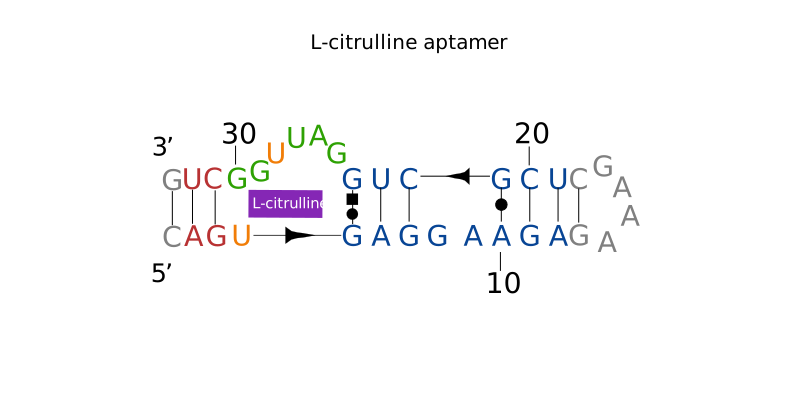
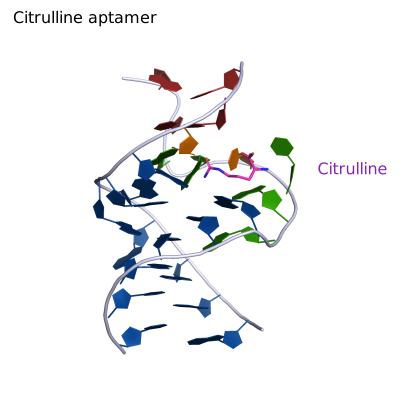
Here we used ribodraw to complete the figure, through the 3D structure information. The L-citrulline aptamer aptamer was named by Famulok, M. in the article[1].
5'-CAGUGAGGAAGAGAAAGCUCGCUGGAUUGGCUG-3'
|
|
Binding pocket
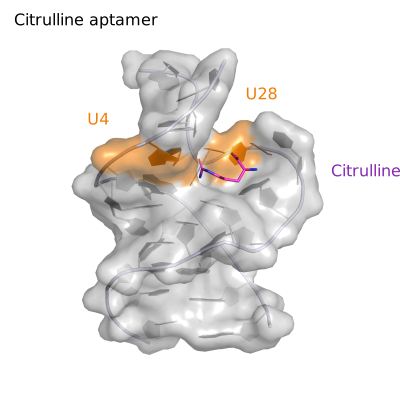
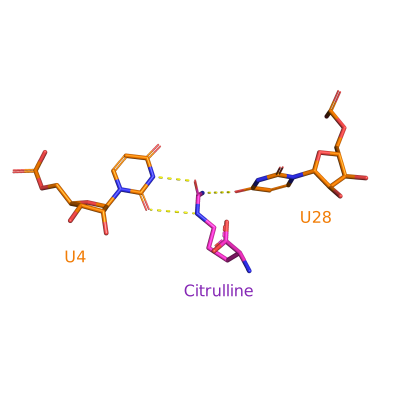
Left: Surface representation of the binding pocket of the aptamer generated from PDB ID: 1KOD by NMR. Citrulline (shown in sticks) is labeled in magenta. Right: The hydrogen bonds of binding sites of the aptamer bound with Citrulline.
|
|
Ligand information
SELEX ligand
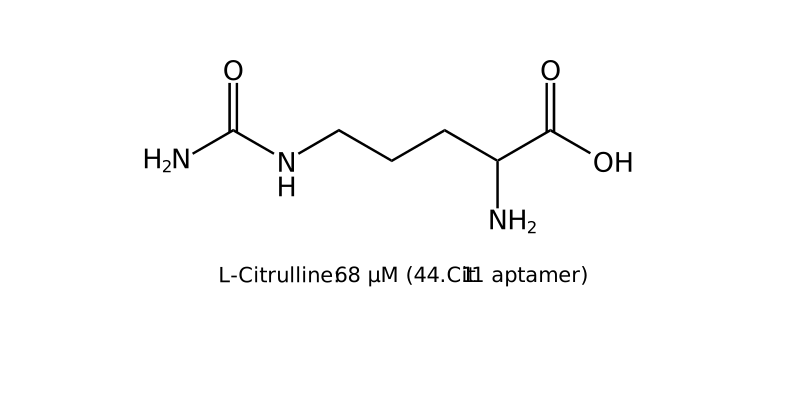
Famulok, M. determined the dissociation constants Kd for L-citrulline RNA conjugates and L-arginine RNA conjugates in solution. The methods used for this purpose are isocratic elution chromatography and equilibrium gel filtration, which allow for a comprehensive assessment of the stability and affinity of the interactions under a variety of experimental conditions. These methods allow a robust assessment of the binding affinity dynamics of RNA with L-citrulline and L-arginine in different environments. The affinity of Citrulline RNA aptamer for L-Citrulline is 68 μM, and the rest demonstrates the affinity of Arginine RNA aptamer[1].
Structure ligand
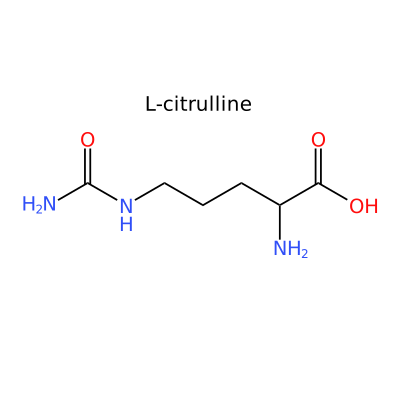
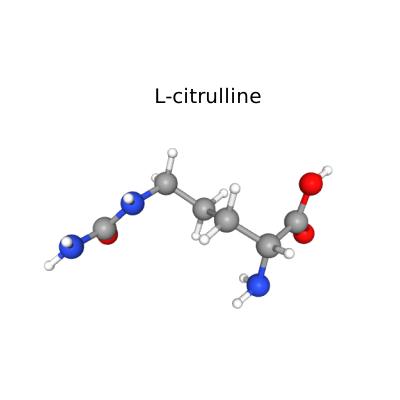
L-citrulline is the L-enantiomer of citrulline. It has a role as an EC 1.14.13.39 (nitric oxide synthase) inhibitor, a protective agent, a nutraceutical, a micronutrient, a human metabolite, an Escherichia coli metabolite, a Saccharomyces cerevisiae metabolite and a mouse metabolite. It is an enantiomer of a D-citrulline. It is a tautomer of a L-citrulline zwitterion.-----From ChEBI
PubChem CID: a unique identifier for substances in the PubChem database.
CAS number: a global registry number for chemical substances.
Drugbank: a comprehensive database with detailed information on drugs and drug targets.
| PubChem CID | Molecular Formula | Molecular Weight | CAS | Solubility | Drugbank ID |
|---|---|---|---|---|---|
| 9750 | C6H13N3O3 | 175.19 g/mol | 372-75-8 | ≥ 50 mg/mL | DB00155 |
 |
 |
Similar compound(s)
We screened the compounds with great similarity to Citrulline by using the ZINC database and showed some of the compounds' structure diagrams. For some CAS numbers not available, we will supplement them with Pubchem CID.
ZINC ID: a compound identifier used by the ZINC database, one of the largest repositories for virtual screening of drug-like molecules.
PubChem CID: a unique identifier for substances in the PubChem database.
CAS number: a global registry number for chemical substances.
| ZINC ID | Name | CAS | Pubchem CID | Structure |
|---|---|---|---|---|
| ZINC000001532749 | D-Arginine | 157-06-2 | 71070 | 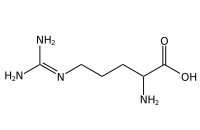 |
| ZINC000004556609 | N5-Iminoethyl-L-Ornithine | NA | 40489058 | 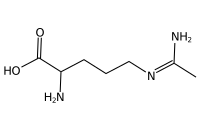 |
| ZINC000001532525 | Arginine | 74-79-3 | 6322 | 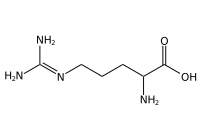 |
| ZINC000002166829 | D-Citrulline | 13594-51-9 | 637599 | 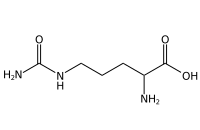 |
References
[1] Molecular Recognition of Amino Acids by RNA aptamers: An L-Citrulline Binding RNA Motif and Its Evolution into an L-Arginine Binder.Michael Famulok
Journal of the American Chemical Society 1994 116 (5), 1698-1706 (1994)
[2] Structural probing and damage selection of citrulline- and arginine-specific RNA aptamers identify base positions required for binding.
P Burgstaller, M Kochoyan, M Famulok
Nucleic acids research. 1995 Dec 11;23(23):4769-76. (1995)
[3] RNA aptamers that bind L-arginine with sub-micromolar dissociation constants and high enantioselectivity.
A Geiger, P Burgstaller, H von der Eltz, A Roeder, M Famulok
Nucleic acids research. 1996 Mar 15;24(6):1029-36. (1996)
[4] Structural basis of ligand discrimination by two related RNA aptamers resolved by NMR spectroscopy.
Y Yang, M Kochoyan, P Burgstaller, E Westhof, M Famulok
Science. 1996 May 31;272(5266):1343-7. (1996)
[5] Mirror-design of L-oligonucleotide ligands binding to L-arginine.
A Nolte, S Klussmann, R Bald, V A Erdmann, J P Fürste
Nature biotechnology. 1996 Sep;14(9):1116-9. (1996)
[6] Chiral stationary phase based on a biostable L-RNA aptamer.
Agnès Brumbt, Corinne Ravelet, Catherine Grosset, Anne Ravel, Annick Villet, Eric Peyrin
Analytical chemistry. 2005 Apr 1;77(7):1993-8. (2005)